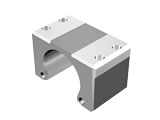
The THK Ball Screw Nut Bracket is a precision-engineered mounting component designed to securely fix ball screw nuts in linear motion systems, ensuring optimal alignment and force transmission. Constructed from high-strength materials such as carbon steel or stainless steel, these brackets feature machined mounting surfaces and precisely located bolt holes to maintain the ball screw nut’s coaxiality with the screw shaft. This rigid fixation minimizes deflection, vibration, and misalignment, which are critical for preserving the accuracy and longevity of the entire drive system. Many models incorporate sealing options to protect the ball screw assembly from contaminants like dust, chips, or moisture, enhancing reliability in harsh environments.
Key technical features include standardized mounting interfaces compatible with THK’s ball screw nut series, allowing for seamless integration into existing linear guides or custom machinery frames. The brackets are often designed with weight-reducing cutouts without compromising structural integrity, and surface treatments such as black oxide or zinc plating provide corrosion resistance. Dimensional tolerances are tightly controlled to ensure repeatable positioning, while some variants include adjustment mechanisms for fine-tuning the nut’s alignment during installation. This attention to detail ensures that the bracket acts as a stable foundation, preventing parasitic motions that could degrade system performance.
Performance advantages begin with enhanced rigidity, which directly translates to higher positional accuracy and repeatability in linear motion. By eliminating free play and reducing elastic deformation under load, the bracket helps maximize the ball screw’s efficiency and thrust capacity. This stability also dampens vibrations, leading to smoother operation and reduced noise levels—particularly beneficial in high-speed applications. Additionally, the robust design distributes loads evenly across the mounting structure, extending the service life of both the ball screw and associated components by preventing stress concentrations. In terms of maintenance, the secure mounting simplifies inspection and replacement procedures, reducing downtime in industrial settings.
Typical applications span across industries where precision linear motion is paramount. In industrial machinery, THK Ball Screw Nut Brackets are used in CNC machining centers to position tooling slides, in semiconductor manufacturing equipment for wafer handling robots, and in packaging machines for synchronized product transfer. Automotive systems leverage these brackets in electric power steering mechanisms for precise rack positioning, in automated assembly lines for robotic welding arms, and in brake testing rigs that require accurate linear displacement control. Precision equipment applications include medical devices such as MRI scanner tables and surgical robots, where smooth, backlash-free movement is critical, as well as coordinate measuring machines (CMMs) and optical alignment systems that demand micron-level accuracy. By providing a reliable interface between the ball screw nut and machine structure, these brackets ensure consistent performance in demanding operational conditions.