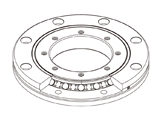
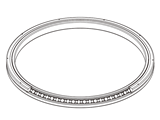
THK Cross Roller Bearings for Inner Ring Rotation represent a specialized class of linear motion components engineered for applications demanding exceptional rotational accuracy, high rigidity, and compact design. These bearings are fundamentally characterized by their unique structural arrangement, where cylindrical rollers are alternately crossed at right angles between the inner and outer rings. This configuration allows the bearing to simultaneously support complex load combinations—including radial loads, axial loads, and moment loads—all within a single, highly integrated unit. The primary design intent for the inner ring rotation variant is to facilitate scenarios where the shaft or the inner ring is the rotating element, a common requirement in many precision machinery setups.
The technical features of these bearings are meticulously crafted to deliver superior performance. The rollers make line contact with the raceways, a critical design aspect that significantly increases rigidity and minimizes elastic deformation under load compared to point contact found in ball bearings. This results in exceptionally smooth and precise rotation with minimal runout. The bearings are available with either a one-piece or split-type inner ring, with the split-type design offering simplified assembly and maintenance, particularly in applications where other components are mounted on the shaft. High-grade bearing steel, advanced heat treatment processes, and precision grinding of all contact surfaces ensure high load capacity, long service life, and consistent performance. Optional sealing units are also available to protect the precision rolling elements from contaminants like dust and moisture, enhancing reliability in harsh operating environments.
The performance advantages of THK Cross Roller Bearings for Inner Ring Rotation are substantial and directly address the challenges of modern industrial automation. Their high rigidity translates into improved machining accuracy and surface finish in equipment like machine tools, as it prevents deflection under cutting forces. The compact cross-section allows for the design of more slender and space-efficient machinery, a crucial factor in robotics and semiconductor manufacturing equipment where every millimeter counts. Furthermore, the ability to handle moment loads eliminates the need for multiple bearing arrangements, simplifying system design, reducing parts count, and lowering overall costs. The high rotational accuracy ensures precise positioning and repeatability, which is paramount in applications like rotary tables, indexing heads, and industrial robot joints.
Typical applications for these bearings are found wherever precision, rigidity, and a compact footprint are non-negotiable. In industrial machinery, they are the core component of rotary tables for machining centers, enabling high-speed, high-precision multi-axis milling and grinding. Within the realm of robotics, they are indispensable in the revolute joints of articulated robot arms, providing the stiff and accurate rotation required for complex assembly and welding tasks. In the automotive sector, they are utilized in advanced manufacturing and testing equipment, such as the rotary indexers for automated assembly lines. Precision equipment, including semiconductor wafer steppers, optical inspection devices, and medical imaging systems like CT scanners, relies on these bearings for their vibration-dampening characteristics and flawless rotational smoothness, ensuring the highest levels of operational fidelity.