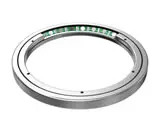
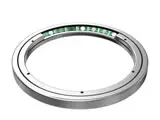
THK Cross Roller Bearings for Outer Ring Rotation represent a specialized linear motion solution engineered for applications requiring high rigidity, precise rotational accuracy, and compact design. These bearings feature a unique structure where cylindrical rollers are arranged crosswise at 90-degree intervals between the inner and outer rings, with each roller alternating in orientation. This cross-roller configuration enables the bearing to simultaneously withstand radial, axial, and moment loads without the need for multiple bearing arrangements, making it ideal for outer ring rotation scenarios where the outer ring is the rotating element while the inner ring remains stationary.
Key technical features include the use of precision-ground rollers and raceways that ensure smooth, low-friction rotation and minimal rotational torque variation. The compact and lightweight design minimizes the overall footprint of machinery, allowing for more efficient use of space in constrained applications. THK employs high-grade steel and advanced heat treatment processes to enhance durability and wear resistance, while optional seals or shields protect against contaminants like dust and moisture, extending service life in harsh environments. The bearings are available in various sizes and preload levels, enabling customization for specific operational requirements, such as high-speed rotation or ultra-precise positioning.
Performance advantages of THK Cross Roller Bearings for Outer Ring Rotation are substantial. They deliver exceptional rotational accuracy, with runout tolerances as low as a few micrometers, ensuring repeatable performance in precision tasks. The high rigidity minimizes elastic deformation under load, maintaining stability and reducing vibration, which is critical for applications involving dynamic forces. Additionally, the optimized roller contact geometry distributes loads evenly, reducing stress concentrations and extending fatigue life. This results in lower maintenance needs and reduced downtime, contributing to overall operational efficiency. The bearings also operate quietly and efficiently, even at high speeds, making them suitable for noise-sensitive environments.
Typical applications span multiple industries, leveraging the bearing’s strengths in precision and reliability. In industrial machinery, they are commonly used in rotary tables for machining centers, indexing heads, and robotic arm joints, where accurate angular positioning and high load capacity are essential. In automotive systems, these bearings find use in steering mechanisms, transmission components, and testing equipment, providing smooth rotation and durability under variable loads. For precision equipment, they are integral to semiconductor manufacturing devices, optical instruments, and medical imaging systems, where minimal deflection and high rotational accuracy are paramount. Their versatility also extends to aerospace actuators and assembly automation, underscoring their role in advancing modern technology.