Guide Ball Bushing

THK’s Ball Bushing linear motion systems represent a foundational technology in precision guidance, utilizing recirculating ball bearings within a shaft and bushing arrangement to deliver smooth, low-friction linear movement. These systems are engineered around a compact, highly efficient design where the ball bushing, typically comprising a outer sleeve and precision-engineered ball retainer, travels along a hardened and ground shaft. The core innovation lies in the recirculation path; as the bushing moves, the balls circulate endlessly through a loaded raceway and a return guide, ensuring a constant supply of rolling elements between the contacting surfaces. This fundamental principle eliminates sliding friction, replacing it with the far superior efficiency of rolling contact.

The technical features of the THK Ball Bushing are defined by their rigorous construction and material science. The shaft is manufactured from high-carbon chromium bearing steel, hardened to Rockwell C60 or higher, and finished with a super-grinding process to achieve exceptional straightness, surface smoothness, and dimensional accuracy. The bushing itself is often made from high-quality carbon steel for strength and durability. Critical to its performance is the ball retainer or cage, which prevents ball-to-ball contact, minimizing heat generation, wear, and noise. Many models incorporate seals or shields integrated into the bushing ends to effectively exclude contaminants like dust and chips while retaining grease, thereby maintaining performance and longevity in harsh environments.

This design translates into significant performance advantages. The primary benefit is an extremely low coefficient of friction, which allows for high-speed operation, reduced driving force requirements, and minimal heat generation. The high rigidity of the system ensures precise positioning and repeatability, critical for automated processes. Furthermore, the recirculating ball design offers a long service life and sustained accuracy, as wear is distributed evenly across the ball circuit. The lubrication system is optimized for maintenance efficiency, with many units being pre-lubricated and designed for easy re-lubrication intervals, contributing to reduced downtime.

Typical applications for THK Ball Bushing systems are vast and span across demanding industrial sectors. In industrial machinery, they are ubiquitous in the linear axes of machine tools, providing the precise movement for milling, grinding, and drilling heads. They are integral to automated assembly lines, driving the motion of pick-and-place robots, sliding doors, and material handling equipment. Within the automotive industry, these bushings are found in precision testing and inspection rigs, welding robot arms, and various automation cells on production lines. For precision equipment, their low friction and high accuracy make them ideal for the stages of semiconductor manufacturing apparatus, medical diagnostic devices, and precision measuring instruments, where every micron of movement counts.

MORE +
CLOSE +
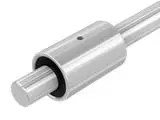
The THK Guide Ball Bushing Model LG represents a significant advancement in linear motion technology, engineered to deliver exceptional precision, rigidity, and durability in demanding industrial applications. This compact, high-performance linear bushing features a unique design with a steel retainer that securely holds precision-ground balls in optimal contact with the shaft, ensuring smooth, low-friction motion with minimal variation in torque. The LG model incorporates a specialized gothic arch groove configuration in both the bushing and shaft interface, which enhances load distribution and increases ball contact area for higher load capacity and longer service life. Key technical features include its ability to handle substantial radial, reverse radial, and moment loads simultaneously, thanks to the optimized ball circulation system that prevents skidding and reduces wear. The bushing is constructed from high-carbon chromium bearing steel, heat-treated to achieve a surface hardness of 58-64 HRC, providing excellent resistance to abrasion and fatigue. It is available in standard, adjustable, and open types, allowing for precise clearance adjustments to compensate for mounting errors or thermal expansion. The LG model also boasts a compact cross-section, making it ideal for applications with space constraints, and it can operate effectively at temperatures ranging from -10°C to 80°C without significant performance degradation. Performance advantages of the THK LG Guide Ball Bushing include its high positional accuracy, with repeatability within micrometers, and its ability to maintain smooth operation even under high-speed conditions, reaching linear velocities up to 2 m/s. The low coefficient of friction minimizes energy consumption and heat generation, contributing to extended component life and reduced maintenance requirements. Its sealed design, often equipped with grease fittings, protects against contaminants like dust, chips, and moisture, ensuring reliable performance in harsh environments. Additionally, the bushing's compatibility with various shaft materials and finishes allows for customization to specific application needs, enhancing versatility across industries. Typical applications span a wide range of sectors, including industrial machinery where the LG model is used in CNC machine tools for precise table movements, automated assembly lines for robotic arms, and packaging equipment for linear guidance systems. In automotive systems, it facilitates accurate positioning in engine machining centers, suspension testing rigs, and brake assembly lines, where high load capacity and durability are critical. For precision equipment, the bushing is integral to semiconductor manufacturing devices, optical instrument stages, and medical imaging systems, providing the stability and smooth motion necessary for micron-level accuracy. Overall, the THK Guide Ball Bushing Model LG stands as a robust, reliable solution for enhancing efficiency and precision in modern automation and machinery.
View