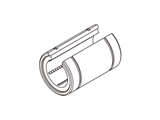
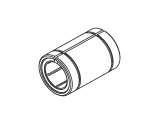
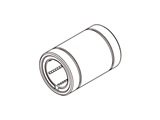
The THK LME and LME OP SERIES Linear Bushings represent a high-performance, cylindrical ball bushing solution engineered to European dimensional standards, delivering exceptional precision, durability, and smooth linear motion in a compact, versatile package. These components are fundamental for constructing highly efficient linear motion systems across a diverse spectrum of industrial automation, automotive manufacturing, and precision instrumentation.
Technically, the LME SERIES is characterized by its cylindrical outer sleeve with a precision-ground bore, designed for easy press-fitting into a standard housing unit. The critical innovation lies in its internal structure, which incorporates a precision-engineered ball recirculation system. This system features a retainer that effectively guides the load-bearing balls through a seamless, infinite circuit, ensuring consistently smooth and low-friction travel. The LME OP SERIES builds upon this robust foundation by integrating a unique, pre-loaded ball contact structure. This design eliminates internal clearance between the bushing and the shaft, resulting in zero backlash, significantly enhanced rigidity, and improved positional accuracy, which is paramount for applications involving reversing motion or subjected to moment loads. Both series are manufactured from high-carbon chromium bearing steel, subjected to a rigorous heat treatment process to achieve a super-hardened surface, providing outstanding resistance to wear, indentation, and fatigue, thereby guaranteeing a long operational lifespan even under demanding conditions.
The performance advantages of these linear bushings are substantial. Their low-friction coefficient translates directly into higher mechanical efficiency, allowing for reduced drive power requirements and enabling higher operational speeds. The smooth, precise motion minimizes vibration and noise, contributing to quieter machine operation and higher quality output. The high rigidity and load capacity, particularly of the LME OP models, ensure stability and accuracy under combined loads, including radial, reverse radial, and moment loads. Furthermore, their standardized cylindrical design simplifies installation and maintenance, reducing machine assembly time and total cost of ownership.
Typical applications for the THK LME and LME OP SERIES are widespread. In industrial machinery, they are indispensable in the linear axes of automated assembly robots, pick-and-place units, material handling systems, and the sliding bases of machine tools like drilling and milling machines. Within the automotive sector, they are deployed in precision testing equipment, robotic welding arms, and automated assembly lines for engines and transmissions. For precision equipment, these bushings are found in the critical positioning stages of semiconductor manufacturing apparatus, optical inspection devices, and medical diagnostic instruments where flawless, repeatable motion is non-negotiable. Their reliability and precision make them a cornerstone component for engineers designing advanced, high-speed, and high-accuracy automated systems.