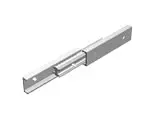
THK Slide Rail Aluminum Alloy systems represent a sophisticated class of linear motion components engineered for applications demanding a blend of high performance, lightweight construction, and exceptional corrosion resistance. These systems utilize precision-engineered slide rails constructed from high-grade aluminum alloy, paired with recirculating ball or roller bearing technology within the carriage blocks to facilitate smooth, low-friction linear travel. The inherent properties of the aluminum alloy material are central to their design philosophy, offering a significant reduction in moving mass compared to traditional steel rail systems without compromising structural rigidity or load-bearing capacity.
Key technical features include the anodized surface treatment of the aluminum rails, which dramatically enhances surface hardness and provides superior resistance to oxidation and chemical corrosion, making them ideal for harsh environments, including those with exposure to moisture, coolants, or washdown procedures. The precision-ground raceways integrated into the rail ensure high geometric accuracy and straightness, which is critical for maintaining consistent performance and positioning repeatability. These systems are available in various accuracy grades and preload levels, allowing for optimization based on specific application requirements for rigidity, vibration damping, and smoothness of operation. Many models also incorporate integrated sealing systems, such as scrapers and seals, to effectively exclude contaminants like dust and chips while retaining lubrication, thereby ensuring long service life and minimal maintenance.
The performance advantages are substantial. The lightweight nature of the aluminum alloy rails reduces the overall system inertia, enabling higher acceleration and deceleration rates, which translates into faster cycle times and improved throughput in automated machinery. This characteristic also reduces the power requirements and size of the driving actuators, such as servo or stepper motors, leading to more energy-efficient and compact machine designs. Despite their lighter weight, these slide rails exhibit high static and dynamic load capacities, supporting significant moments and forces in multiple directions. The low-friction operation ensures smooth, precise movement with minimal stick-slip, contributing to higher positioning accuracy and repeatability, often in the micron range. The combination of corrosion resistance and sealed designs results in exceptional reliability and longevity, even in demanding conditions where steel components might succumb to rust or premature wear.
Typical applications for THK Slide Rail Aluminum Alloy systems are widespread across industries where precision, speed, and environmental resilience are paramount. In industrial automation, they are extensively used in the gantry systems of pick-and-place robots, linear actuators for assembly stations, and as guiding elements in automated packaging and material handling equipment. Within the automotive manufacturing sector, they are found in precision testing and measurement jigs, welding robot arms, and parts transfer systems that require rapid, accurate motion. In the realm of precision equipment, these components are indispensable in semiconductor manufacturing apparatus, medical and diagnostic devices like DNA analyzers and automated sample handlers, and high-speed CNC machining centers for tool positioning, where their lightweight and corrosion-resistant properties ensure contamination-free and highly reliable operation.