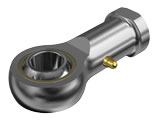
Rod End

THK Rod Ends represent a specialized category of spherical plain bearings engineered to accommodate angular misalignment and oscillating movements within mechanical assemblies. These components consist of a high-precision, hardened steel ball stud housed within a spherical inner ring, which is itself encased in a robust outer ring. The entire assembly is designed to facilitate smooth, low-friction rotational and swiveling motion across multiple axes, making them indispensable for linking mechanical elements in systems where alignment is not perfectly static. A critical technical feature is the incorporation of THK’s advanced lubrication technology; many models are pre-lubricated and feature integrated seals or shields that effectively retain grease and exclude contaminants like dust, moisture, and metal chips. This significantly extends service life and reduces maintenance requirements. The materials used are typically high-carbon chromium bearing steel for the ball stud and rings, often with surface treatments or alternative materials like stainless steel available for enhanced corrosion resistance in harsh environments.

The performance advantages of THK Rod Ends are substantial, primarily revolving around reliability, precision, and durability. Their low starting and running torque ensures responsive and efficient power transmission in linkage mechanisms. The high static and dynamic load capacities allow them to withstand significant forces, including shock loads, without compromising the integrity of the movement. This robust construction minimizes backlash and wear, leading to consistent positional accuracy over extended periods. By effectively managing misalignment, they prevent binding and reduce stress concentrations on connected parts, which in turn lowers noise and vibration, contributing to smoother overall system operation and prolonged lifespan for the entire machinery.

In industrial machinery, THK Rod Ends are ubiquitous in applications requiring precise articulation. They are fundamental components in the linkage systems of industrial robots, where they connect actuators to arms and grippers, enabling complex, multi-axis movements with high repeatability. They are also found in the control rods of packaging machinery, conveyor system guides, and the adjustable linkages within printing and textile equipment. Within the automotive sector, these rod ends are critical for safety and performance. They are employed in steering tie-rod ends, throttle linkage connections, and suspension components like stabilizer bar links, where they must reliably transmit steering inputs and absorb road-induced vibrations. For precision equipment, such as optical positioning stages, semiconductor manufacturing tools, and medical diagnostic devices, the high precision and minimal play of THK Rod Ends are essential. They ensure that fine adjustments in linkages translate into accurate, repeatable movements, which is paramount for the functionality and accuracy of such sensitive instruments.

MORE +
CLOSE +
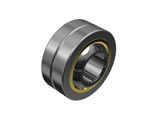
THK Rod End Spherical Bearings are precision-engineered components designed to accommodate angular misalignment and oscillating movements while transmitting loads in linear and rotational motion systems. These bearings consist of a spherical inner ring and an outer ring with a cylindrical shank, featuring a stud or housing that enables secure attachment to adjacent components. The critical aspect of their performance and longevity lies in their lubrication system, which is engineered to maintain optimal operation under demanding conditions. The lubrication design of THK Rod End Spherical Bearings incorporates high-grade lithium soap-based grease or specialized synthetic lubricants, tailored to withstand extreme temperatures, high loads, and repetitive motion. These lubricants are packed into the bearing during manufacturing, filling the clearance between the spherical surfaces to minimize friction and wear. Key technical features include a sealed structure that prevents lubricant leakage and contamination from external debris, moisture, or corrosive agents. Some models are equipped with grease fittings for re-lubrication, allowing for maintenance in long-term applications without disassembly. The lubricant's viscosity and additive package are optimized to provide a stable oil film, reducing metal-to-metal contact and preventing fretting corrosion, even in low-speed or oscillating motions. This ensures consistent torque characteristics and smooth articulation over the bearing's service life. Performance advantages of properly lubricated THK Rod End Spherical Bearings are substantial. They exhibit reduced friction coefficients, leading to lower energy consumption and heat generation in systems. The enhanced wear resistance extends the bearing's operational lifespan, minimizing downtime and maintenance costs. In high-load scenarios, the lubricant distributes stress evenly across the spherical contact area, preventing premature fatigue and failure. Additionally, the corrosion-inhibiting properties of the grease protect against degradation in harsh environments, such as those with exposure to chemicals or humidity. This results in reliable, quiet operation with minimal vibration, which is critical for precision applications. Typical applications span various industries, leveraging these benefits. In industrial machinery, THK Rod End Spherical Bearings are used in linkage mechanisms of robotic arms, conveyor systems, and packaging equipment, where they accommodate misalignments and ensure smooth, repetitive motions. In automotive systems, they serve in steering linkages, throttle controls, and suspension components, providing durability under dynamic loads and varying temperatures. For precision equipment, such as medical devices, optical instruments, and semiconductor manufacturing tools, the bearings' low-friction and high-precision characteristics support accurate positioning and reduce backlash. Overall, the advanced lubrication of THK Rod End Spherical Bearings underpins their reliability, making them indispensable in applications demanding high performance, longevity, and minimal maintenance.

View
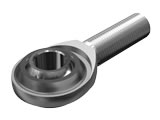
THK's Rod End with Male Thread represents a significant advancement in spherical plain bearing technology, specifically engineered for applications requiring maintenance-free operation and reliable performance in demanding environments. This self-lubricating rod end eliminates the need for periodic lubrication, making it ideal for systems where accessibility is limited or where lubricant contamination could compromise operational integrity. The unit features a high-strength steel male thread for secure mounting, paired with a spherical inner ring and an outer ring that incorporates a specially formulated lubricant-impregnated polymer liner. This design ensures smooth angular movement and rotation while maintaining consistent performance across a wide temperature range. Key technical features include the integration of a maintenance-free lubrication system, where the polymer liner continuously releases lubricant during operation, reducing friction and wear without external intervention. The male thread is precision-machined to standard metric or imperial specifications, ensuring compatibility with existing components and simplifying installation. The rod end's construction provides high static and dynamic load capacities, with corrosion-resistant options available for harsh environments. Additionally, the design minimizes backlash and play, enhancing positional accuracy and system stability. Performance advantages are substantial, starting with extended service life due to reduced wear on moving surfaces. The no-lubrication requirement lowers total cost of ownership by eliminating maintenance downtime and lubricant expenses. It operates effectively in temperatures from -30°C to +80°C, maintaining reliability in varied conditions. The rod end's low friction characteristics contribute to energy efficiency, while its sealed design prevents ingress of contaminants like dust, moisture, or chemicals, ensuring consistent operation in dirty or exposed settings. Vibration damping properties further protect connected components from shock loads and oscillations. Typical applications span multiple industries, leveraging these benefits in critical systems. In industrial machinery, it is used in linkage mechanisms, control rods, and actuation systems for packaging equipment, printing presses, and material handling conveyors, where precise motion transfer and durability are essential. Automotive systems employ it in throttle linkages, suspension components, and steering assemblies, benefiting from its vibration resistance and maintenance-free operation over long service intervals. Precision equipment applications include optical positioning systems, medical device actuators, and semiconductor manufacturing tools, where the rod end's minimal play and clean operation prevent contamination while ensuring repeatable accuracy. This versatility makes THK's Rod End with Male Thread a robust solution for enhancing performance and reliability across diverse mechanical systems.
View
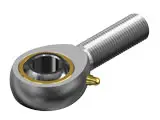
THK's Rod End with Male Thread represents a precision-engineered spherical plain bearing solution designed to accommodate angular misalignment while transmitting rotational or linear motion in demanding industrial applications. This component features a high-carbon chromium bearing steel inner ring heat-treated to HRC 58-64, paired with a pressed steel outer ring that ensures durability under oscillating or rotating movements. The male thread—available in metric and imperial specifications—enables direct installation into threaded mounting points without additional adapters, simplifying assembly in constrained spaces. A critical design element is its integrated lubrication system: the rod end contains grease reservoirs and lubrication holes that permit periodic regreasing using standard grease nipples. This maintenance feature significantly extends service life by flushing out contaminant particles and replenishing the special low-torque, high-temperature resistance grease pre-applied during manufacturing. Performance advantages stem from THK's proprietary surface treatment technologies and precision manufacturing tolerances. The ball slides within a hardened raceway with a surface finish of 0.2 μm Ra maximum, achieving a friction coefficient of just 0.003-0.007 under lubricated conditions. This ultra-low friction enables smooth articulation up to ±25° angular misalignment while maintaining positional accuracy within 0.05mm. The component's corrosion resistance is enhanced through black oxide coating or zinc nickel plating options, withstanding operational temperatures from -30°C to +120°C. Compared to standard rod ends, THK's design demonstrates 40% higher dynamic load capacity due to optimized contact stress distribution, alongside 30% longer lifespan under high-frequency oscillation conditions. Vibration damping characteristics absorb shock loads up to 15G acceleration without compromising motion transmission accuracy. In industrial machinery, these rod ends serve as crucial linkages in packaging equipment articulation joints, where they maintain precision in repetitive pick-and-place motions while resisting contamination from food particles or industrial dust. Automotive steering systems utilize them in tie rod connections, where their sealed design prevents road salt ingress while providing the necessary angular compliance for wheel alignment adjustments. Robotics applications employ them in parallel manipulator arms, where low torque characteristics reduce servo motor loads during continuous path tracing operations. For precision equipment, they function in optical instrument positioning stages, maintaining sub-micron repeatability through elimination of stick-slip phenomena. The regreasing capability proves particularly valuable in semiconductor manufacturing equipment, where continuous operation necessitates maintenance without disassembly in cleanroom environments. Through these implementations, THK's Rod End with Male Thread delivers reliable angular motion compensation while addressing lubrication challenges across diverse motion control scenarios.
View
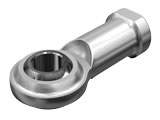
THK Rod End Female Threading No Lubrication components represent a specialized category of linear motion joints engineered for applications where traditional lubrication is impractical or undesirable. These rod ends feature a female threading design, allowing for direct attachment to male-threaded shafts or studs, and incorporate self-lubricating properties to eliminate the need for external grease or oil. Constructed from high-strength materials such as chromium molybdenum steel or stainless steel, the bodies are precision-machined to maintain dimensional stability under load. The critical innovation lies in the integration of lubricant-impregnated polymer liners within the bearing surface, which gradually release lubricants during operation to reduce friction and wear. This design ensures consistent performance without manual maintenance, making them ideal for environments where contamination from lubricants must be avoided. Key technical features include corrosion-resistant coatings or material selections for harsh conditions, such as zinc-nickel plating or passivated stainless steel finishes. The female threading is manufactured to international standards like ISO or JIS, ensuring compatibility with common industrial fasteners. Internal clearances are optimized to minimize backlash while accommodating minor misalignments, which is essential for maintaining precision in dynamic systems. The no-lubrication aspect is achieved through advanced composite materials in the bearing liner, which provide a low coefficient of friction and high resistance to abrasive particles. Additionally, these components often include sealing mechanisms to prevent ingress of contaminants like dust or moisture, further extending service life in demanding settings. Performance advantages center on reliability and reduced maintenance overhead. By eliminating lubrication intervals, these rod ends lower long-term operational costs and minimize downtime in automated machinery. They exhibit excellent wear resistance, with tested lifespans exceeding those of conventional lubricated joints in high-cycle applications. The self-lubricating design ensures stable torque characteristics and smooth articulation, reducing vibration and noise in motion systems. This consistency is crucial for applications requiring repeatable positioning, as it prevents performance degradation over time. Furthermore, the absence of external lubricants eliminates risks of oil leakage, which could compromise product purity in cleanrooms or food processing equipment. Typical applications span industrial machinery, automotive systems, and precision equipment. In industrial automation, they are deployed in robotic arm linkages, conveyor system pivots, and packaging machine actuators, where frequent movement demands maintenance-free operation. Automotive uses include throttle linkages, suspension components, and steering mechanisms, benefiting from their vibration damping and corrosion resistance. For precision equipment, such as semiconductor manufacturing tools or medical device actuators, these rod ends provide the clean, predictable motion necessary for micron-level accuracy. Their ability to function in extreme temperatures—from cryogenic environments to high-heat engine compartments—makes them versatile for aerospace and energy sectors as well. By combining durability with zero-lubrication requirements, THK’s rod ends address the growing demand for efficient, contamination-free linear motion solutions across modern industries.
View
THK Rod End Female Threading Lubrication represents a specialized category of linear motion components engineered to deliver reliable articulation and load support in linkage mechanisms. These rod ends feature a female-threaded shank, designed for direct attachment to threaded rods or studs, and incorporate a self-lubricating spherical plain bearing within the housing. The integral lubrication system is a critical feature, utilizing either pre-applied, long-life lubricants or engineered polymer composites that function as solid lubricants. This design ensures consistent, low-friction performance across the spherical bearing's range of motion, accommodating multi-directional misalignment while transmitting forces efficiently. Key technical features include the use of high-carbon chromium bearing steel for the inner and outer rings, often through-hardened or surface-treated to achieve high wear resistance and durability under repetitive oscillating or rotating motions. The spherical sliding surface is precision-ground to maintain tight tolerances, minimizing play and ensuring smooth, precise movement. The lubrication is sealed within the bearing assembly by high-performance seals, which protect against contamination from dust, moisture, and other particulates—common in harsh industrial environments. This sealing mechanism prevents lubricant leakage and ingress of abrasive elements, significantly extending the component's service life. Thread specifications are standardized, such as metric fine or coarse threads, and are manufactured to precise class tolerances to ensure secure, backlash-free connections. Performance advantages are substantial, starting with reduced maintenance requirements. The long-lasting lubrication eliminates the need for frequent re-lubrication, lowering total cost of ownership and minimizing machine downtime. The low-friction characteristics contribute to higher efficiency in mechanical systems, reducing energy consumption and heat generation. These rod ends exhibit excellent resistance to shock loads and vibrations, maintaining integrity and alignment accuracy even under dynamic operating conditions. Their ability to compensate for angular misalignment prevents binding and reduces stress on adjacent components, leading to more reliable system performance and prolonged equipment lifespan. Typical applications span multiple sectors where precise linkage and articulation are paramount. In industrial machinery, they are commonly employed in packaging equipment, textile machines, and printing presses, where they facilitate smooth motion control in cam followers, levers, and adjustment linkages. Automotive systems utilize them in steering linkages, throttle controls, and suspension components, where their durability and maintenance-free operation enhance vehicle safety and performance. Within precision equipment, such as semiconductor manufacturing tools or medical devices, these rod ends provide the exacting motion stability and cleanliness required, with lubrication systems that avoid particulate generation. Their robust design also suits heavy-duty applications in construction equipment and agricultural machinery, where they endure high loads and environmental exposure while ensuring operational reliability.
View