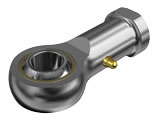
THK Rod End Female Threading Lubrication represents a specialized category of linear motion components engineered to deliver reliable articulation and load support in linkage mechanisms. These rod ends feature a female-threaded shank, designed for direct attachment to threaded rods or studs, and incorporate a self-lubricating spherical plain bearing within the housing. The integral lubrication system is a critical feature, utilizing either pre-applied, long-life lubricants or engineered polymer composites that function as solid lubricants. This design ensures consistent, low-friction performance across the spherical bearing’s range of motion, accommodating multi-directional misalignment while transmitting forces efficiently.
Key technical features include the use of high-carbon chromium bearing steel for the inner and outer rings, often through-hardened or surface-treated to achieve high wear resistance and durability under repetitive oscillating or rotating motions. The spherical sliding surface is precision-ground to maintain tight tolerances, minimizing play and ensuring smooth, precise movement. The lubrication is sealed within the bearing assembly by high-performance seals, which protect against contamination from dust, moisture, and other particulates—common in harsh industrial environments. This sealing mechanism prevents lubricant leakage and ingress of abrasive elements, significantly extending the component’s service life. Thread specifications are standardized, such as metric fine or coarse threads, and are manufactured to precise class tolerances to ensure secure, backlash-free connections.
Performance advantages are substantial, starting with reduced maintenance requirements. The long-lasting lubrication eliminates the need for frequent re-lubrication, lowering total cost of ownership and minimizing machine downtime. The low-friction characteristics contribute to higher efficiency in mechanical systems, reducing energy consumption and heat generation. These rod ends exhibit excellent resistance to shock loads and vibrations, maintaining integrity and alignment accuracy even under dynamic operating conditions. Their ability to compensate for angular misalignment prevents binding and reduces stress on adjacent components, leading to more reliable system performance and prolonged equipment lifespan.
Typical applications span multiple sectors where precise linkage and articulation are paramount. In industrial machinery, they are commonly employed in packaging equipment, textile machines, and printing presses, where they facilitate smooth motion control in cam followers, levers, and adjustment linkages. Automotive systems utilize them in steering linkages, throttle controls, and suspension components, where their durability and maintenance-free operation enhance vehicle safety and performance. Within precision equipment, such as semiconductor manufacturing tools or medical devices, these rod ends provide the exacting motion stability and cleanliness required, with lubrication systems that avoid particulate generation. Their robust design also suits heavy-duty applications in construction equipment and agricultural machinery, where they endure high loads and environmental exposure while ensuring operational reliability.