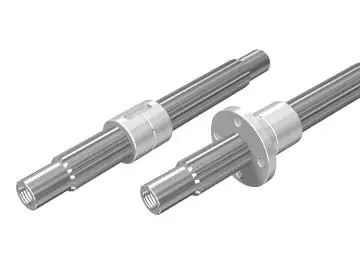
THK Spline Nuts represent a specialized class of linear motion components engineered for applications demanding the simultaneous transmission of torque and linear motion with exceptional precision and rigidity. These nuts are designed to engage with spline shafts, featuring internal grooves that mesh perfectly with the corresponding teeth on the shaft. This unique coupling mechanism allows the nut to slide smoothly along the shaft’s axis while being locked rotationally, enabling it to withstand significant torsional loads and moments without backlash. The fundamental principle involves the precise geometry of the spline profile, which ensures a large contact area between the nut and shaft, distributing loads evenly and enhancing overall system stability.
Key technical features of THK Spline Nuts include their high torque capacity and rigidity, achieved through advanced manufacturing techniques that guarantee precise tooth form accuracy and minimal clearance. Many models incorporate a crowned spline profile or optimized lead to prevent edge loading and ensure smooth, consistent motion across the entire travel length. The nuts are typically manufactured from high-carbon chromium bearing steel, hardened and ground to provide superior wear resistance and long-term dimensional stability. To further enhance performance and service life, options such as seals and shields are available to protect the critical spline engagement from contaminants like dust, chips, and moisture, making them suitable for harsh operating environments.
The performance advantages of integrating THK Spline Nuts into a motion system are substantial. Their primary benefit is the ability to handle complex load conditions, combining high thrust, radial, and moment loads in a single, compact unit. This eliminates the need for separate torque transmission devices, simplifying machine design, reducing the number of components, and saving valuable space. The rigid construction and precise meshing result in highly accurate, repeatable linear positioning with virtually no angular play, which is critical for maintaining precision in automated processes. Furthermore, their robust design ensures high durability and reliability, leading to reduced maintenance requirements and lower total cost of ownership over the system’s lifecycle.
Typical applications for THK Spline Nuts are found wherever precise linear movement must be coupled with the transmission of rotational force. In industrial machinery, they are indispensable in the rotary tables of machining centers, where they provide both the vertical support for the table and the means to rotate it accurately for multi-sided machining. Within automotive manufacturing systems, these nuts are employed in robotic welding and assembly arms, enabling the precise positioning of heavy tools while managing the reactive torques generated during operation. In the realm of precision equipment, they are critical components in semiconductor manufacturing apparatus, such as wafer handling robots, and in various inspection and measuring machines, where their high rigidity and accuracy ensure flawless performance in sensitive, high-throughput processes.