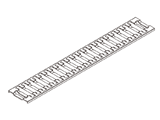
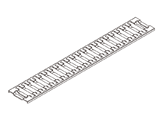
Flat Surface Type Model FT

THK’s Flat Roller Flat Surface Type Model FT represents a specialized linear motion solution engineered for applications demanding exceptional rigidity, high load capacity, and smooth, precise travel along a flat surface. This system fundamentally departs from traditional ball-based guides by utilizing cylindrical rollers as the rolling elements within its compact, single-axis unit. The core of the Model FT consists of a robust guide rail with precisely ground raceways and a carriage block that houses the rollers, which are retained by a highly durable resin retainer. This retainer is critical, as it prevents skewing and ensures the rollers circulate smoothly, maintaining consistent contact and eliminating metal-to-metal contact between the rollers themselves to minimize wear, vibration, and noise generation.

The technical features of the Model FT are defined by its roller-based design. The line contact of the rollers with the raceway, as opposed to the point contact of balls, is the primary source of its performance advantages. This contact geometry grants the system an exceptionally high load rating in all directions—radial, reverse-radial, and lateral. Its static load capacity is substantially greater than similarly sized ball guide systems, making it inherently more rigid and resistant to elastic deformation under heavy loads or moment forces. This results in unparalleled positional accuracy and stability, with minimal deflection during operation. The optimized recirculation path and the use of high-grade, case-hardened steel for all critical components ensure high durability, long service life, and consistent performance even in demanding environments characterized by shock, vibration, and continuous heavy-duty cycles.

These performance characteristics make the THK Model FT an ideal choice for a wide range of demanding industrial applications. In industrial machinery, it is frequently specified for the critical axes of machine tools, such as in the feed mechanisms of machining centers, grinding machines, and turning centers, where its high rigidity directly translates to improved surface finish and part tolerances. Within the realm of automotive manufacturing systems, the FT model is found in high-precision welding robots, heavy-duty transfer lines, and precision press-feeding equipment, where it reliably handles high moment loads and repetitive, high-impact operations. For precision equipment, its stability and smooth motion are indispensable in semiconductor manufacturing apparatus, including wafer steppers and probing machines, as well as in precision inspection and measuring instruments where even micron-level vibration or deflection is unacceptable. The THK Flat Roller Flat Surface Type Model FT, therefore, stands as a superior motion component for engineers seeking to maximize stiffness, load capacity, and precision in the most challenging automation and production environments.

MORE +
CLOSE +
THK's Flat Roller Flat Surface Type Model FT/FT V SERIES represents a significant advancement in linear motion technology, engineered to deliver exceptional precision, rigidity, and durability in demanding industrial environments. This series utilizes flat rollers arranged in a unique configuration to achieve smooth, low-friction linear guidance along flat surfaces, making it an ideal solution for applications requiring high load capacity and minimal maintenance. The design incorporates precision-ground raceways and optimized roller geometry, ensuring consistent performance even under heavy loads or high moment forces. Key technical features of the FT/FT V SERIES include its compact, space-saving profile, which allows for easy integration into machinery with limited installation space. The flat roller mechanism provides superior rigidity and shock resistance compared to traditional ball-based systems, reducing deflection and enhancing positional accuracy. With pre-loaded rollers and advanced sealing options, the series offers excellent resistance to contaminants such as dust, chips, and moisture, extending service life in harsh operating conditions. Additionally, the FT V variant includes integrated lubrication units for automated maintenance, further reducing downtime and operational costs. Performance advantages are evident in its ability to handle complex load scenarios, including high moment loads and overturning forces, without compromising smoothness or precision. The low-friction design minimizes energy consumption and heat generation, contributing to improved efficiency and longer component life. Noise and vibration levels are significantly reduced, making it suitable for high-speed applications where quiet operation is critical. The series also supports high positioning accuracy and repeatability, essential for tasks requiring meticulous alignment or rapid cycling. Typical applications span across industrial machinery, automotive systems, and precision equipment. In industrial automation, the FT/FT V SERIES is commonly used in machine tools, transfer systems, and assembly robots where heavy loads and precise linear motion are paramount. Within the automotive sector, it facilitates reliable performance in welding equipment, painting lines, and engine assembly systems, enduring rigorous production cycles. For precision equipment, such as semiconductor manufacturing devices, medical imaging systems, or optical positioning stages, the series ensures stable, vibration-free operation critical to achieving micron-level accuracy. Its versatility and robustness make it a preferred choice for engineers seeking to enhance reliability and productivity in diverse mechanical systems.
View
THK's Flat Roller Flat Surface Type Model FT Series represents a specialized linear motion solution engineered for applications demanding exceptional rigidity, high load capacity, and precise, stable movement along a flat surface. This system fundamentally departs from traditional ball-based guides by utilizing cylindrical rollers as the rolling elements within its compact, integrated carriage and rail assembly. The FT Series is specifically designed to withstand substantial moments and loads, making it an optimal choice for replacing complex, custom-machined slide mechanisms with a standardized, high-performance, off-the-shelf component. The technical architecture of the FT Series is defined by several critical features. Its core innovation lies in the flat roller and flat raceway design. The rollers make line contact with the raceways, a significant advantage over the point contact of ball screws, resulting in a dramatically increased load-bearing area. This design inherently provides a higher static and dynamic load rating. The carriage is a rigid, single-unit block that houses multiple rows of precision-ground rollers, which are retained by a highly durable resin cage. This cage ensures smooth, continuous recirculation of the rollers, minimizing vibration and noise while preventing skewing and jamming. The rail is manufactured with hardened and precision-ground raceways, guaranteeing long-term accuracy and wear resistance. For installation, the rail features tapped holes along its length, simplifying mounting and alignment onto a machine base. Performance advantages derived from this robust design are substantial. The most prominent benefit is its superior load capacity and rigidity, which allows the FT Series to handle heavy loads and high moment loads—such as overturning, lateral, and pitching moments—with minimal deformation. This results in exceptional positional accuracy and repeatability, even under demanding operating conditions. The line contact of the rollers also contributes to a longer service life and reduced maintenance requirements compared to ball-based systems subjected to similar loads. The compact cross-sectional profile of the unit saves valuable space within machinery, while the standardized design drastically reduces design time, manufacturing costs, and lead times associated with custom-built sliding tables. Typical applications for the THK FT Series are found in industrial sectors where robust, reliable linear motion is non-negotiable. In industrial machinery, it is extensively used in heavy-duty automation equipment, such as high-precision machining centers for workpiece positioning, automated assembly lines for transferring heavy components, and in precision press-feeding mechanisms. Within the automotive manufacturing sector, these guides are ideal for welding robot bases, heavy-duty material handling arms, and precision fixturing and testing equipment that must withstand constant, high-force cycles. In the realm of precision equipment, the FT Series provides the stable foundation required for high-accuracy measurement instruments, semiconductor manufacturing equipment stages, and optical alignment devices where minimal deflection under load is critical for maintaining process integrity.

View